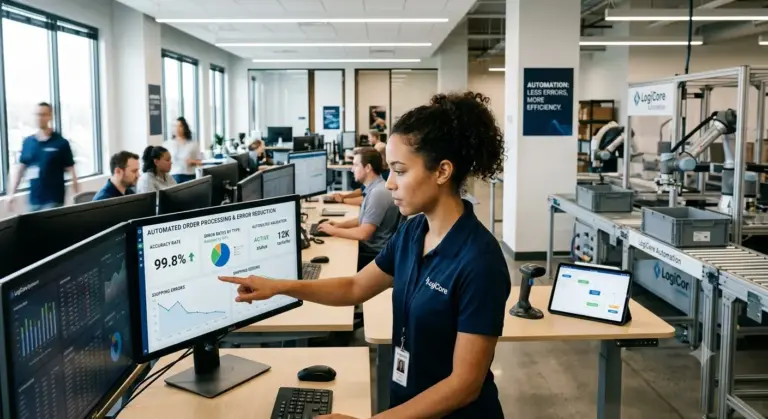

A fully automated workflow from inquiry to invoice is no longer a luxury for large enterprises – it is a practical reality for any growing business willing to set it up.
From inquiry to invoice fully automated workflow – this is the goal every business owner imagines but very few actually build.
Think about what your current process looks like.
A potential customer reaches out. Someone picks it up – eventually. A quote gets prepared manually. It gets sent over email or WhatsApp. The customer says yes. Someone creates an invoice from scratch. It gets sent. Payment follow-up happens manually. The data gets entered into a spreadsheet. The report gets compiled at the end of the month.
Every single step in that journey involves a human doing something that a system could do automatically – faster, more accurately, and without ever getting distracted, tired, or forgetful.
Now imagine the same journey where every step flows into the next one automatically. The inquiry is captured. The lead is assigned. The quote is generated. The follow-up happens on schedule. The invoice is created the moment the deal is confirmed. The payment reminder fires on day one, day seven, and day fourteen. The report updates itself in real time.
No manual data entry. No dropped balls. No delays.
That is what a fully automated workflow from inquiry to invoice looks like. And this blog breaks it down step by step so you can start building it.
Why Most Businesses Are Still Doing This Manually
Before getting into the how – it is worth understanding why so many businesses are still running this process manually despite the tools to automate it being widely available and affordable.
The honest answer is inertia.
The manual process works – barely, but well enough that fixing it never feels urgent. Until a deal falls through because of a missed follow-up. Or a cash flow problem develops because invoices went out late. Or a key team member leaves and half the sales knowledge walks out the door with them.
By the time the pain is obvious enough to act on, the business has lost far more than the cost of building the automated system would ever have been.
Do not wait for the crisis. Build the system before it hurts.
Stage 1: Inquiry Capture
Every automated workflow starts at the same place – the moment a potential customer expresses interest.
Inquiries come in through multiple channels simultaneously. Website contact forms. WhatsApp messages. Social media DMs. Phone calls logged by the team. Walk-ins noted at the front desk. Referrals from existing clients.
In a manual process, each of these lands in a different place and requires someone to manually move it into whatever system the business is using to track leads.
In an automated workflow, every inquiry – regardless of source — flows automatically into the CRM. The web form submits directly. The WhatsApp message triggers an automatic lead creation. The team logs the phone call and the CRM entry is created instantly.
No lead exists outside the system. No inquiry requires manual data entry to get captured.
This is the foundation. If the inquiry is not captured cleanly and consistently, everything that follows breaks down.
Stage 2: Instant Acknowledgement
The moment an inquiry is captured, the lead should receive an acknowledgement.
Not two hours later when someone checks the inbox. Immediately.
An automated acknowledgement message – through WhatsApp, email, or both – confirms that the inquiry has been received, sets an expectation for when someone will follow up, and keeps the lead engaged in the minutes after they first reached out.
This matters more than most businesses realise. The window of highest engagement is right after the inquiry. A fast, professional acknowledgement signals that this business is responsive and serious — and that impression sets the tone for the entire sales process that follows.
Stage 3: Lead Assignment and Qualification
Once the inquiry is captured, the CRM assigns it automatically based on rules the business sets.
By product or service type. By geography. By lead source. By team member availability or workload. By the time of day it came in.
Simultaneously, a qualification flow can begin – an automated WhatsApp or email sequence that asks the lead a few simple questions to understand their requirement, budget, and timeline.
By the time a salesperson picks up the lead for the first human conversation, they already know who this person is, what they are looking for, and whether they are a serious prospect. The conversation starts informed instead of from zero.
Stage 4: Automated Follow-Up Sequence
This is where most businesses lose deals — and where automation delivers its most visible return.
A follow-up sequence is a pre-built series of messages that go out at defined intervals after the initial inquiry. Day one. Day three. Day seven. Each message adds value — a relevant case study, a specific answer to a common question, a gentle nudge toward booking a call.
None of these messages require a human to send. They fire on schedule, every time, to every lead in the pipeline.
The result is a sales process that is consistent regardless of how busy the team is, how many leads are coming in simultaneously, or whether the salesperson remembers to follow up. The system does the remembering.
Businesses that implement proper follow-up automation consistently see a significant increase in lead conversion — not because their pitch changed, but because more leads are actually being followed up with.
Stage 5: Proposal and Quote Generation
Once a lead is ready for a proposal, the manual process typically involves someone sitting down to create a document from scratch — pulling in the relevant products or services, calculating pricing, formatting the document, and sending it over.
This takes time. And it introduces inconsistency — different team members produce different quality proposals, with different pricing calculations, and different formats.
An automated proposal system generates quotes directly from the CRM. The salesperson selects the relevant products or services, the system pulls in the pricing, applies any applicable discounts, formats the proposal to the company standard, and sends it to the lead automatically.
Consistent. Fast. Professional. Every time.
Stage 6: Deal Confirmation and Handoff
When the lead confirms they want to proceed, the CRM marks the deal as won and immediately triggers the next phase of the workflow.
The operations team is notified. A task is created for delivery or onboarding. The customer is sent a confirmation message with next steps. And critically the invoice generation process begins.
No manual handoff. No someone-will-call-you-shortly limbo. The moment the deal is confirmed, the system moves.
Stage 7: Automated Invoice Generation
This is the stage where many businesses still fall back on manual work — and it is one of the most straightforward things to automate.
When the deal is confirmed in the CRM, the invoicing system generates the invoice automatically — pulling the customer details, the agreed products or services, the pricing, and the payment terms directly from the deal record.
The invoice is formatted, branded, and sent to the customer without anyone having to open a separate software, re-enter data that already exists, or wait for the accounts team to have capacity.
The invoice goes out the moment it should — immediately after the deal is confirmed — which means payment comes sooner.
Stage 8: Payment Reminders on Autopilot
An invoice sent is not a payment received.
Payment follow-up is one of the most time-consuming and mentally draining parts of running a business. Nobody enjoys chasing money. But it has to happen — consistently and on time.
Automated payment reminders fire on a schedule tied to the invoice due date. A friendly reminder three days before the due date. A follow-up on the due date. A firmer reminder three days after. A final notice a week after.
All of this happens without a single human having to remember, initiate, or feel awkward about it. The system handles the chase so your team does not have to.
Cash flow improves. The awkward payment conversations reduce dramatically. And the data on who pays on time and who does not becomes visible — informing future business decisions.
Stage 9: Real-Time Reporting
At every stage of this workflow, the system is generating data.
How many inquiries came in this week. How many were qualified. How many proposals were sent. How many deals were confirmed. How much revenue is outstanding versus collected. What the average time from inquiry to invoice is.
In a manual process, assembling this data requires hours of work. In an automated workflow, it updates in real time on a dashboard that anyone with access can see at any moment.
This visibility is what allows business leaders to spot bottlenecks, make faster decisions, and continuously improve the process.
What You Need to Build This
Building this workflow does not require building everything from scratch simultaneously.
The core building blocks are:
A CRM – the central nervous system of the workflow. Every lead, every conversation, every deal stage lives here.
WhatsApp automation – for instant acknowledgements, follow-up sequences, and customer communication at scale.
A proposal or quoting tool – integrated with the CRM so quotes generate from existing deal data.
An invoicing system – connected to the CRM so invoices fire automatically on deal confirmation.
An automation layer – a tool that connects everything and defines the rules for when data flows from one system to another.
Most of these components already exist within platforms like Zoho and Odoo — which is precisely why they are the go-to recommendation for businesses building this kind of end-to-end workflow.
Start Somewhere Not Everywhere
If building the complete workflow from inquiry to invoice in one go feels overwhelming — that is because it is.
Start with the stage that costs you the most time or the most deals right now.
If leads are being missed — start with inquiry capture and instant acknowledgement. If follow-up is inconsistent — start with automated follow-up sequences. If invoicing is slow — start with automated invoice generation.
Build one stage well. Let it run. Measure the improvement. Then build the next one.
Within a few months, the pieces connect — and the workflow starts running as a whole.
The Business That Runs on Systems
There is a version of your business where the inquiry comes in at 11 PM on a Sunday, receives an acknowledgement within seconds, gets added to the CRM automatically, enters a follow-up sequence, receives a proposal by Monday morning, confirms the deal by Tuesday, and has an invoice in their inbox by Tuesday afternoon — without a single person having done anything manually.
That is not a fantasy. That is what building the right systems produces.
The businesses that operate this way are not just more efficient. They close more deals. They get paid faster. They scale without adding proportionally more people. And they deliver a consistently professional experience that builds trust and generates referrals.
Final Thought
From inquiry to invoice fully automated workflow is the backbone of a business that runs on systems instead of effort.
Every manual step in that journey is a place where something can go wrong — a delay, a mistake, a forgotten follow-up, a late invoice. Automation removes those failure points one by one.
You do not need to build everything at once. You just need to start building.
The businesses running smooth, scalable operations today started exactly where you are — with a manual process and the decision to fix it.
Want to map out your inquiry-to-invoice workflow and identify exactly which steps to automate first? Feel free to connect — always happy to help businesses build systems that run themselves.