An enquiry comes in. Someone means to follow up. Days pass. The lead goes cold. Multiply that across a month, and you can see how much revenue quietly slips away.
Lead management is the fix. This guide explains what it is, why it matters for Indian small businesses, and how the process works, step by step. In plain language, with no jargon.
What is lead management?
Lead management is the process of tracking and guiding a potential customer from their first enquiry to a closed sale. It covers how you capture a lead, follow up, qualify their interest, and finally win or lose the deal.
In simple terms, it is how you make sure no enquiry gets forgotten. Instead of leads living in scattered chats, notebooks, and memory, lead management puts them in one clear system with a next step for each.
Good lead management answers three questions at any moment: Who are my leads? Where is each one in the buying journey? What is the next action for each?
If you cannot answer those, you do not have a lead management process yet. You have hope.
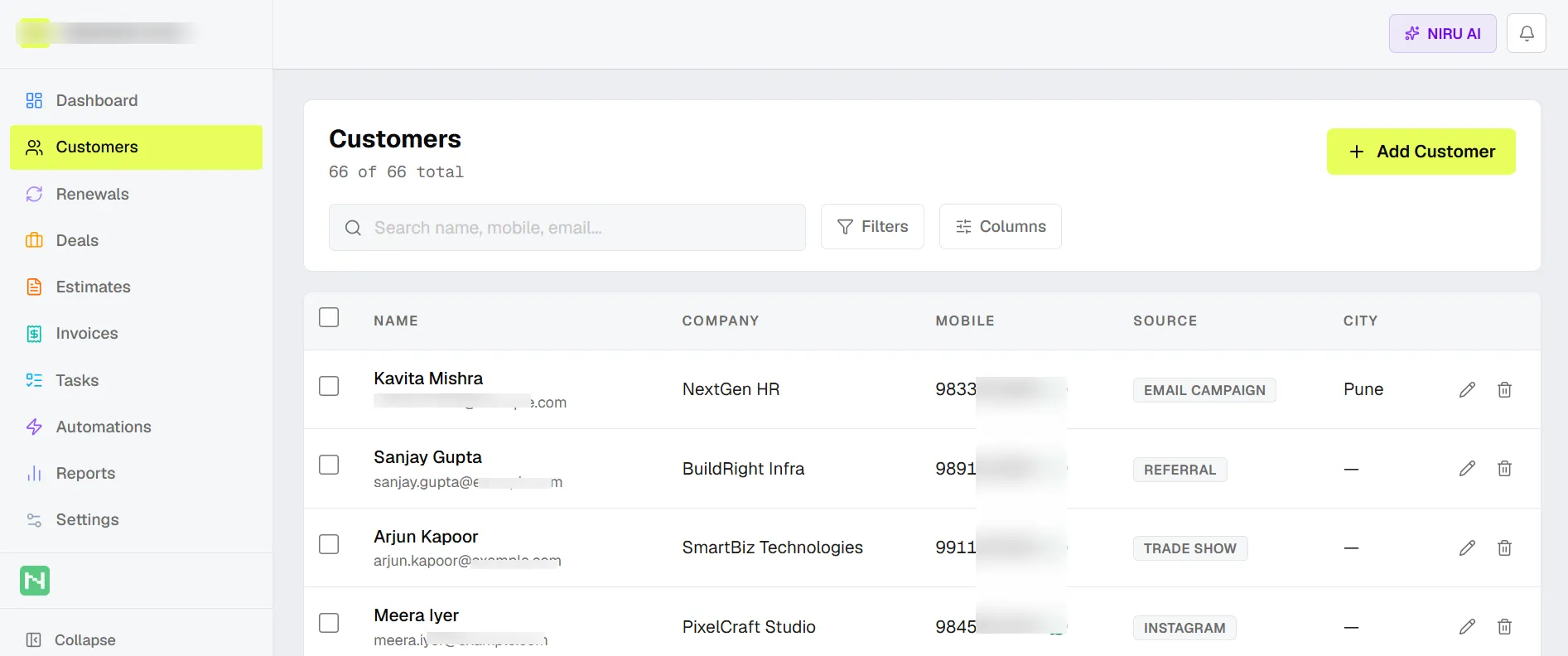
Watch the guide how you can manage contact or leads in NeerSoft CRM
Why lead management matters for Indian SMBs
For a small business, every lead is expensive. You spent money on ads, time on referrals, or effort on your website to earn it. Losing that lead to a missed follow-up is pure waste.
Here is why it matters even more in the Indian SMB context.
Competition is fast. In most local markets, the business that replies first wins. Slow follow-up hands the deal to a competitor.
Budgets are lean. You cannot afford to waste marketing spend on leads that fall through the cracks after you paid to generate them.
Teams are small. When one person juggles sales, delivery, and operations, leads get dropped simply because there is no system holding them.
Strong lead management fixes all three. It makes sure the leads you already paid for actually turn into customers.
The lead management process, step by step
Lead management is not complicated. It follows five clear stages. Understanding them helps you spot where your own process leaks.
1. Lead capture
This is where a lead enters your system. It could be a website form, a social media ad, a phone call, a referral, or a walk-in.
The goal here is simple: no lead should be lost at the door. Every enquiry, from every source, needs to land in one place.
2. Lead tracking
Once captured, each lead needs a record. Name, contact, source, and what they are interested in.
Many Indian businesses start this in a spreadsheet. That works at first. If you are on Excel now, our guide on how to manage leads in Excel shows the right way to set it up.
3. Lead qualification
Not every lead is ready to buy. Qualification is judging how serious and how ready a lead is.
A hot lead wants a quote now. A cold lead is just browsing. Sorting them lets you spend your time where it pays off, instead of chasing everyone equally.
4. Lead nurturing and follow-up
This is where most deals are won or lost. Following up, on time, every time.
A lead that is not ready today may buy next month, if you stay in touch. Timely follow-up keeps you top of mind. This single stage is where a good system matters most, because memory alone always fails as volume grows.
5. Conversion and handoff
Finally, the lead becomes a customer, or is marked lost. Either way, you learn something. Won deals show what works. Lost deals show where you leak.
Tracking this stage is what lets you improve, and answer the question every owner should ask: which sources actually bring me paying customers?
Manual lead management vs using a system
You can manage leads by hand. Many businesses do, at the start. But as enquiries grow, manual methods break in predictable ways.
A spreadsheet has no memory. It will not remind you to follow up. It breaks when two people share it. And it cannot tell you which source converts best.
We cover the true cost of this in our post on CRM vs spreadsheet. The short version: what feels free is quietly costing you deals.
This is where a CRM comes in. A CRM is simply a tool built to run the lead management process for you. It captures leads in one place, tracks every stage, reminds you to follow up, and shows you what is working.
How a CRM makes lead management simple
A good CRM turns the five stages above into a smooth, almost automatic flow.
Leads from your forms and ads land in one list. Each sits on a visual pipeline, so you see its stage at a glance. The system reminds you who to follow up with and when. And it reports on which sources bring your best customers.
That is exactly what NeerSoft CRM is built to do. It is lightweight, affordable, and made for Indian small businesses and agencies that want lead management handled without heavy, complex software.
To see how it all fits together, our complete CRM guide walks through choosing and using a CRM for an Indian business.
The bottom line
Lead management is not a big-company luxury. It is how small businesses stop wasting the leads they worked hard to earn.
Capture every enquiry. Track it. Qualify it. Follow up on time. Learn from the result. Do that consistently, and more of your leads become customers.
Start with a spreadsheet if you must. But the moment follow-ups start slipping, a simple CRM is what turns a leaky process into a reliable one. And that reliability is often what lets a small business scale faster.
Frequently Asked Questions
What is lead management in simple words?
Lead management is the process of tracking a potential customer from their first enquiry to a closed sale. It covers capturing the lead, following up, judging how ready they are to buy, and finally winning or losing the deal, all in one organised system so no enquiry is forgotten.
What are the stages of lead management?
The five main stages are lead capture, lead tracking, lead qualification, nurturing and follow-up, and conversion. Together they move a lead from first contact to a closed deal, and show you which sources bring your best customers.
Do small businesses need a lead management system?
Yes. Even small teams lose deals when leads are scattered across chats, notebooks, and memory. A simple system, or a lightweight CRM, ensures every enquiry is followed up on time, which protects the marketing spend used to generate those leads.
What is the difference between lead management and a CRM?
Lead management is the process. A CRM is a tool that runs that process for you. A CRM captures leads, tracks each stage, reminds you to follow up, and reports on results, turning manual lead management into a reliable, automated flow.
Can I do lead management in Excel?
Yes, for low volumes. A structured spreadsheet can track leads and stages. But it cannot remind you to follow up, does not work well when shared, and offers no reporting, so most growing businesses move to a CRM.
Ritesh Sharma
Ritesh Sharma is the founder of NeerSoft Technology. A Mathematics graduate with 11+ years across marketing, business development and AI training, he builds and ships SaaS products for Indian small businesses. He writes about CRM, automation and building software without a traditional engineering background.