
ERP and why your business needs it is a question every growing business eventually faces — usually right after the moment their current systems stop being enough.
ERP and why your business needs it — these two things are connected in a way that becomes obvious only once a business reaches a certain stage of growth.
Before that stage, spreadsheets work. WhatsApp groups coordinate the team. Separate tools handle sales, billing, and inventory. Things feel manageable — complicated, but manageable.
Then something shifts.
The team grows. The client list expands. Operations get more complex. And suddenly the tools that worked at twenty clients are breaking under the weight of two hundred. Data is everywhere and nowhere. Decisions take too long because the information needed to make them is scattered across five different systems. Errors appear that nobody can trace. And the business owner finds themselves spending more time managing the complexity of their tools than actually running the business.
This is the moment ERP becomes not just relevant — but necessary.
What Is ERP — Simply Explained
ERP stands for Enterprise Resource Planning.
The name sounds intimidating. The concept is not.
An ERP system is software that connects all the core functions of a business — sales, finance, inventory, purchasing, HR, operations, and reporting — into one unified platform.
Instead of your sales data living in one tool, your inventory in another, your finances in a third, and your HR in a spreadsheet — an ERP brings all of this into a single system where every department can see the same information in real time.
Think of it as the central nervous system of your business. When one part moves, the rest of the system knows about it immediately — without anyone having to manually communicate, transfer, or re-enter data.
A sale is confirmed. The inventory updates. The invoice is generated. The finance dashboard reflects the new revenue. The delivery team is notified. All of this happens automatically — connected — because it all lives in the same system.
That is ERP in practice.
ERP Is Not Just for Large Enterprises
This is the most persistent misconception about ERP — and it holds back thousands of growing businesses from adopting technology that would genuinely transform their operations.
ERP was originally designed for large manufacturing companies with complex, multi-department operations. For a long time, the cost and complexity of implementation meant it was only accessible to businesses with large IT budgets and dedicated technology teams.
That is no longer the case.
Modern cloud-based ERP platforms — like Odoo and Zoho — have made ERP accessible to businesses with as few as five to ten employees. The implementation cost has come down dramatically. The complexity of setup has reduced significantly. And the modular nature of modern ERP means you start with only what you need and add more as your business grows.
A trading company in Pune with fifteen employees. A manufacturing business in Nashik with thirty. A services firm in Mumbai with ten consultants and a growing client list. These are not enterprise businesses — and all of them benefit significantly from ERP.
NeerSoft Technology has implemented ERP systems for exactly these kinds of businesses — SMEs, startups, and growing companies across India that needed something more powerful than disconnected tools but more accessible than a traditional enterprise system.
https://youtu.be/qZsWuCL1yXc?si=Z7EP2PfM7vKS24CJ: What Is ERP and Why Does Your Business Need It?“Neersoft completely transformed our online presence. Their strategies led to a 200% increase in traffic, driving significant growth for our business.” — Verified client review, neersoft.com
What Happens Inside a Business Without ERP
Before understanding why ERP matters — it helps to see clearly what happens inside a business that does not have it.
The sales team manages leads in a CRM — or in a spreadsheet, or in someone’s head. When a deal closes, they inform the operations team verbally or through WhatsApp.
The operations team receives the information informally. They check inventory manually. They update a separate spreadsheet. They coordinate delivery through personal communication.
The finance team creates an invoice manually — pulling client details from one place, pricing from another, GST rates from memory. They track payments in their own spreadsheet.
The management team needs a report. Someone spends two hours pulling numbers from each department, combining them manually, and producing a document that is already partially outdated by the time it is shared.
Every handoff in this process is manual. Every manual handoff is a place where information can be lost, delayed, or changed. Every changed piece of information is a potential error that cascades downstream.
This is not a description of a badly run business. This is the standard operating reality of most growing businesses in India that have not yet implemented ERP.
What Changes When ERP Is Implemented
One Source of Truth for the Entire Business
Every department sees the same data — live, accurate, and updated in real time.
The sales manager knows the current inventory levels before making a commitment to a client. The finance team sees a new sale the moment it is confirmed. The operations team knows what needs to be delivered without waiting for a WhatsApp message from sales.
No conflicting information. No outdated spreadsheets. No one department operating on a different version of reality than another.
Automated Workflows Between Departments
ERP does not just store data centrally — it automates the flow of work between departments based on that data.
When a purchase order is approved, the payment process initiates. When inventory falls below a threshold, a reorder alert fires. When a project milestone is completed, the billing stage advances automatically.
The manual coordination that currently consumes hours of team time every week — the WhatsApp messages, the status calls, the “just checking in” emails — is replaced by automatic triggers that move work forward without human intervention.
Real-Time Financial Visibility
This is the benefit that most business owners describe as the single most transformative change after ERP implementation.
At any moment — without calling the accounts team, without waiting for a monthly report, without opening a single spreadsheet — a business owner with ERP can see:
Current revenue versus last month. Outstanding invoices and overdue payments. Expenses by category. Profit margins by product or service. Cash flow projections for the next thirty days.
This visibility changes how decisions are made. Instead of operating on instinct and quarterly summaries, leaders make daily decisions grounded in current financial reality.
Inventory and Procurement Control
For businesses managing physical goods — manufacturing, trading, retail, distribution — inventory errors are among the most costly problems an ERP solves.
Overselling products that are not in stock. Underordering raw materials that delay production. Holding excess inventory that ties up capital unnecessarily. All of these are symptoms of inventory managed without real-time visibility.
ERP connects inventory to sales, to purchasing, and to finance — so every transaction updates stock levels automatically and procurement decisions are driven by live data rather than manual counts.
Scalability Without Proportional Complexity
Perhaps the most strategically important benefit of ERP for growing businesses.
Without ERP, growth means more complexity — more team members to coordinate, more systems to manage, more handoffs to track, more errors to fix. The administrative load grows proportionally with the business.
With ERP, growth means more volume flowing through the same connected system. The coordination happens automatically. The reporting aggregates itself. The handoffs are managed by the software.
A business that implements ERP at twenty clients can handle two hundred clients with the same team — because the system absorbs the volume that manual processes cannot.
Odoo vs Zoho — Which ERP Is Right for Your Business?
The two most commonly implemented ERP platforms for growing Indian businesses are Odoo and Zoho — and choosing between them is one of the most important decisions in the implementation process.
Odoo is an open-source ERP platform that is deeply customisable. It can be shaped to match virtually any business workflow — standard or complex — and scales without ceiling. It is the preferred choice for businesses with unique or complex processes, manufacturing operations, multi-warehouse inventory, or specific industry requirements.
NeerSoft’s Odoo implementation begins with a thorough mapping of your business processes — ensuring the system is built around how your business actually works, not a generic template.
Zoho is a cloud-based suite with strong out-of-the-box Indian compliance — GST, TDS, and e-invoicing all built in. It is faster to deploy, easier for teams to adopt, and particularly well-suited for service businesses, consultancies, and SMEs with standard operational processes.
NeerSoft’s Zoho implementation brings official partner-level expertise — better pricing than direct purchase and an implementation approach that ensures adoption, not just setup.
If you are unsure which is right for your business — book a free discovery call with NeerSoft. The right recommendation depends on your specific business size, industry, and operational complexity.
Signs Your Business Is Ready for ERP
Not every business needs ERP immediately — but these are the clearest signs that it is time:
Your team is spending significant time on manual data transfer between systems. This is the most reliable indicator. When people are doing what software should be doing, ERP is the solution.
You do not have real-time visibility into your financials, inventory, or pipeline. If getting the numbers requires a meeting or a manually compiled report, the data infrastructure is not working for you.
Errors are increasing as you grow. Wrong invoices, inventory discrepancies, missed deliveries, conflicting information given to clients — all of these scale with manual processes. ERP eliminates the root cause.
You are managing more than two or three disconnected tools. Each disconnected tool is a data silo. ERP replaces the silos with a single connected system.
Your team coordination is becoming a management challenge. If keeping departments aligned is consuming significant leadership time, ERP automates the coordination that is eating into strategic focus.
You are planning to scale significantly in the next twelve to twenty-four months. Implement ERP before the growth, not during it. Building the system while the business is scaling creates twice the complexity.
What a Good ERP Implementation Looks Like
This matters as much as which platform you choose — because a poorly implemented ERP is worse than no ERP at all.
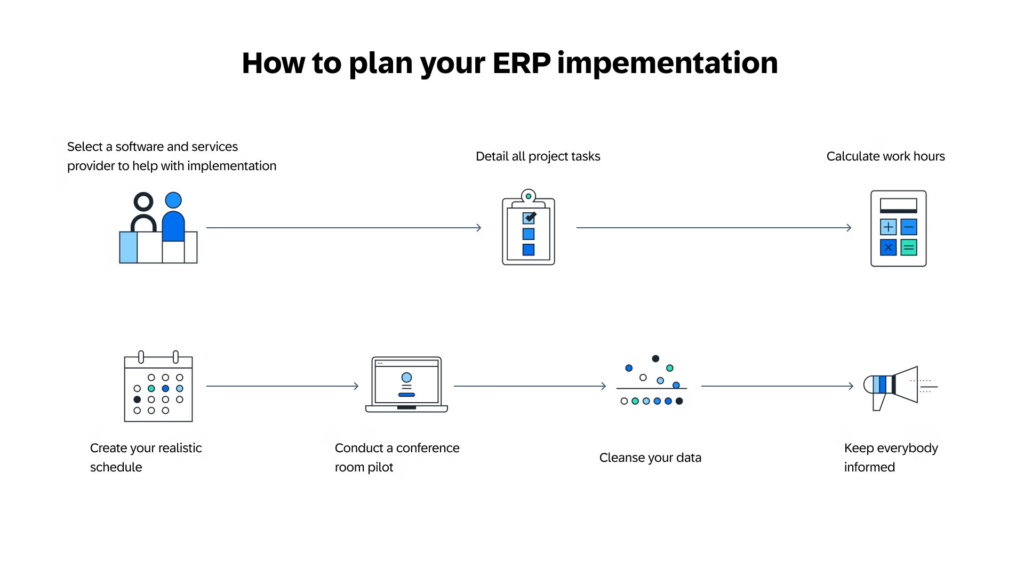
A good ERP implementation starts with process mapping. Before a single line of configuration is written, the implementation partner needs to understand your business deeply — your workflows, your team structure, your reporting requirements, your integration needs, and your most common pain points.
This is exactly how NeerSoft Technology approaches every implementation. The technical work follows the business understanding — not the other way around.
A complete implementation includes:
Process mapping and system design — your workflows translated into system configuration.
Data migration — your existing data moved cleanly from spreadsheets or previous systems into the ERP without loss or corruption.
Customisation — the system adapted to your specific needs rather than forcing your team to adapt to generic defaults.
Training — your team genuinely understands how to use the system, not just where to click.
Post-go-live support — someone available when questions arise after the system is live, not just during the setup phase.
“Neersoft is always available, delivering exceptional results with a positive attitude and dedication.” — Verified client review, neersoft.com
The difference between a system your team loves and one they quietly abandon is almost always in the quality of the implementation — not the quality of the platform.
The Cost Question
The honest answer on ERP cost is — it depends significantly on the platform, the scope of implementation, and the complexity of your business.
What is consistent is the return on investment calculation.
Take the hours your team currently spends on manual data entry, report compilation, cross-system coordination, and error correction. Multiply by your average hourly cost. Add the revenue cost of errors that reach customers and the leads lost to poor follow-up systems.
For most growing businesses, this calculation makes ERP one of the clearest investments available — with returns that begin within the first ninety days and compound as the business grows.
Because NeerSoft is an official partner for both Odoo and Zoho, clients access partner-level pricing that is significantly better than going directly to the platform — making the investment more accessible than most business owners expect.
Final Thought
ERP and why your business needs it comes down to one fundamental question — do you want your business to run on systems, or on the memory, effort, and availability of your team?
Systems scale. Memory does not. Effort has a ceiling. Systems do not.
Every growing business eventually reaches the point where connected, automated operations are not optional — they are the foundation that makes the next stage of growth possible.
The businesses implementing ERP today are building that foundation. The ones waiting are making the eventual transition harder with every month of additional manual complexity.
Start the conversation now — before the chaos makes starting harder.
Ready to explore whether ERP is the right next step for your business? Book a free discovery call with NeerSoft Technology or connect directly on WhatsApp — trusted by 170+ businesses across India to implement ERP systems that actually work.